
Movements of a Nearby Mountain
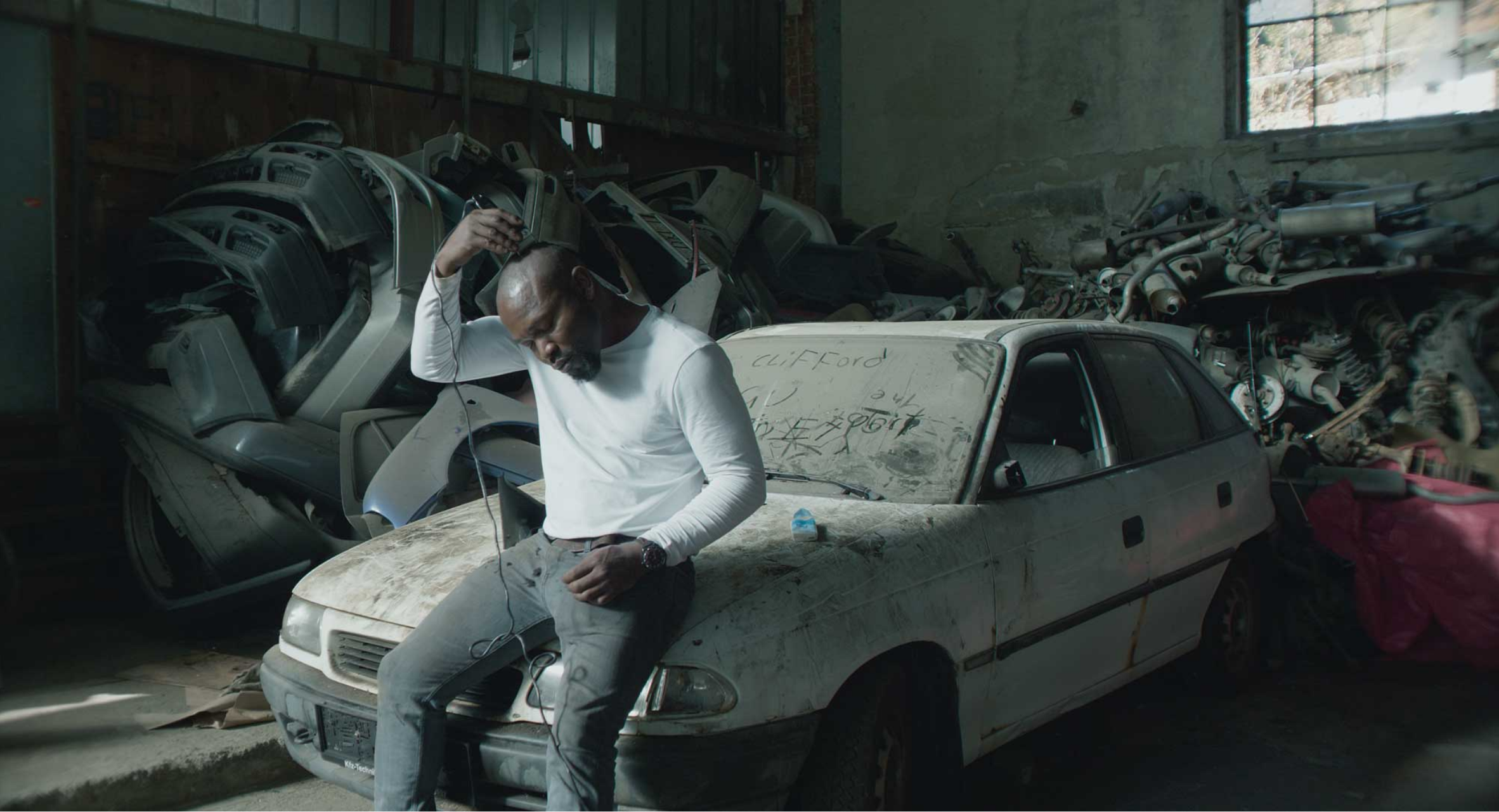
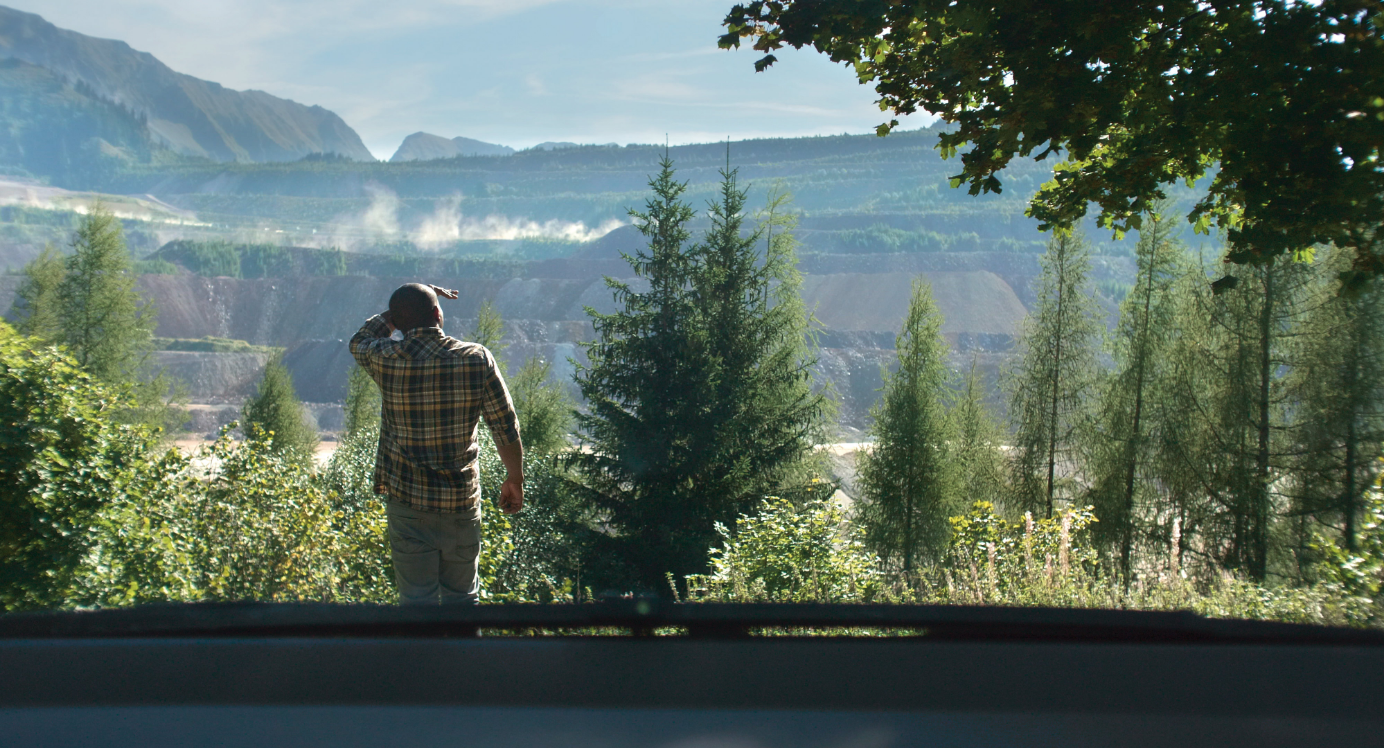
In a remote, abandoned industrial site near a centuries-old ore mine in the Austrian Alps, a self-taught mechanic runs a business exporting used cars to his native Nigeria. As he pursues his lonely day-to-day activities with wondrous serenity, past, present and future begin to overlap, and memories of a lost friendship resurface against the backdrop of a mysterious promise of everlasting resources.
Country, year
Austria, France, 2019
Runtime
85 min
Writer, director
Sebastian Brameshuber
Cinematography
Klemens Hufnagl
Additional cinematography
Jenny Lou Ziegel
Editors
Dane Komljen
Sebastian Brameshuber
Artistic consultant, dramaturgy
Bárbara Palomino Ruiz
Sound engineer, sound design
Johannes Schmelzer-Ziringer
Re-recording mixer
Simon Apostolou
Co-producer
Le Fresnoy
Producers
Ralph Wieser
David Bohun
Sebastian Brameshuber
Mischief Films
Panama Film
Film format
4K digital 1:1.77
Super 16mm 1:1.66
Screening format
DCP 2k, 1:1.85, Dolby 5.1
Austrian release date
September 27, 2019
Supported by
BKA
FISA
Kultur Land OÖ
Cine Art Steiermark
Land NÖ
Project development supported by
Creative Europe Media
ÖFI
FFW
Distribution
Filmgarten
World premiere
Cinéma du Réel 2019
Festivals (selection)
Cinéma du Réel, Paris 2019
Art of the Real, Film at Lincoln Center, New York 2019
Duisburger Filmwoche 2019
Filmfest Hamburg 2019
Open City Documentary Festival, London 2019
Mostra Internacional de Cinema de São Paulo 2019
DokuFest Prizren 2019
Ji.hlava International Documentary Film Festival 2019
Doclisboa 2019
IDFA 2019
FIDOCS, Santiago de Chile 2019
FICUNAM, Mexico City 2020
Awards
Grand Prix, Cinéma du Réel 2019
3sat-Dokumentarfilmpreis, Duisburger Filmwoche 2019
Open City Award, Open City Documentary Festival, London 2019
Spezialpreis der Jury, Wiener Filmpreis 2019
Preis "Der Politische Film", Filmfest Hamburg 2019
Nomination, Österreichischer Filmpreis, Best Documentary 2020
Nomination, Bild-Kunst Schnitt Preis, Edimotion 2020
Beste Bildgestaltung Spielfilm, Diagonale, Graz 2019
Local Artist Award, Crossing Europe Filmfestival Linz 2019







1/7
Cinema as an open space involving things not visible at first glance
Alejandro Bachmann talking to Sebastian Brameshuber about "Movements of a Nearby Mountain"
Interview from the press kit
Dustin Chang, Screenanarchy
Jacques Mandelbaum, Le Monde
Fabien Lemercier, Cineuropa
Marko Stojiljković, Ubiquarian
Ludovic Lamant, Mediapart
Jury statement, Grand Prix, Cinéma du Réel 2019
“Uprooting, migration, adaptation, life and survival are processes both distant and omnipresent and affect people as well as things. Sebastian Brameshuber lends cinematic form to these movements of thought, demanding a magical materialism that is as unpretentious as it is elaborate.”
Jury statement, 3sat-Dokumentarfilmpreis, Duisburger Filmwoche
The Objects and Myths of the Market
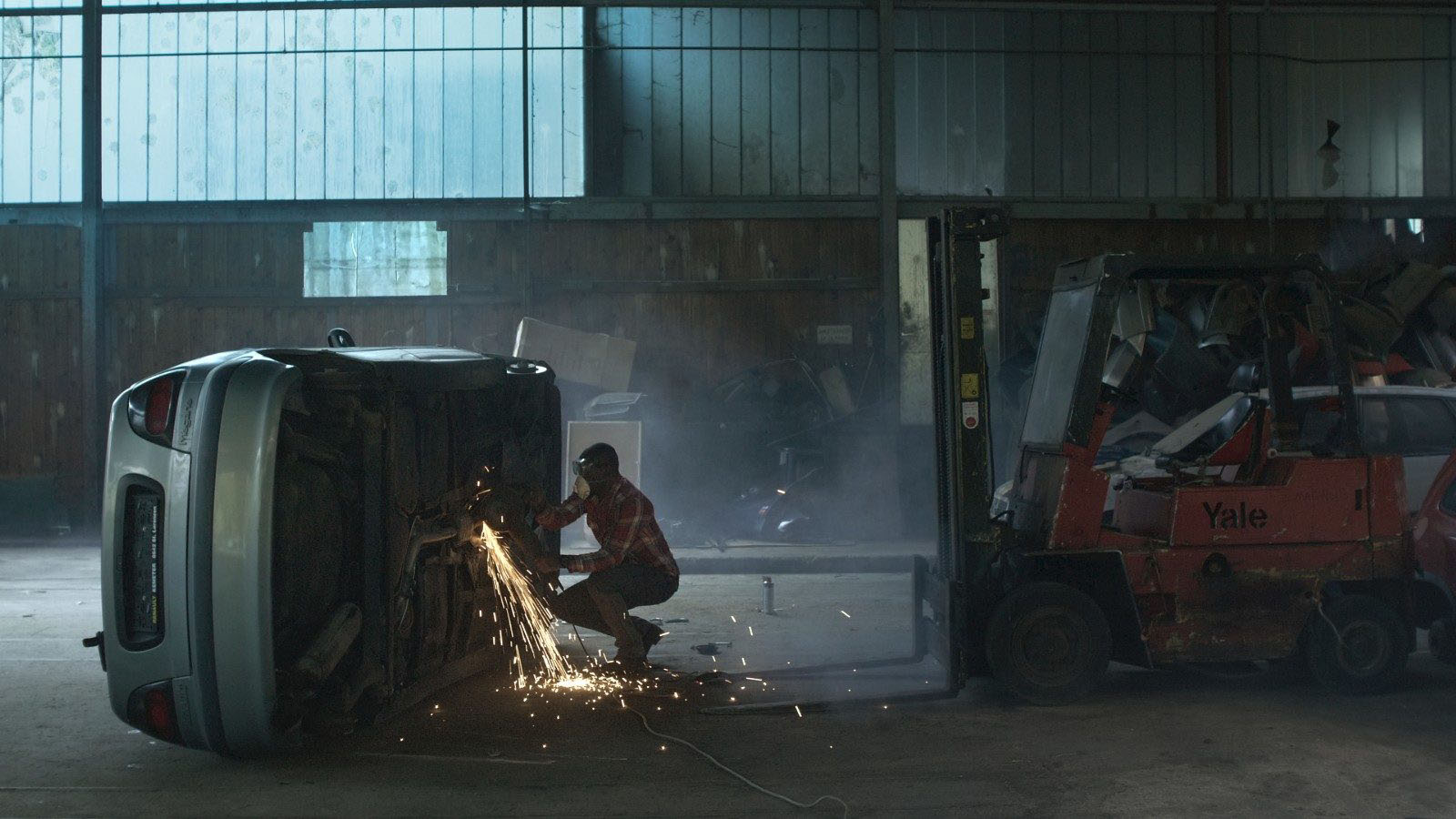
I. Beyond the race for technological innovation, cartel-like collusion in the auto parts industry, and the ominous interplay of marketing and emission levels, at the base of the Erzberg mine in Styria (central-western Austria), Sebastian Brameshuber discovers a part of the automobile market that is seemingly not so alienated. A Nigerian immigrant in Austria, Cliff buys old cars in order to salvage them in a dilapidated warehouse on the side of a federal highway in the woods. Yet “salvage” hardly seems to describe what Movements of a Nearby Mountain shows us of this work. One would come closer to what Cliff carries out in summer and winter in nearly complete isolation if one were to name each of the procedures one by one — the selection, evaluation, disassembly, ordering, labeling, packing, and reconditioning for themarket in his former homeland — that Cliff himself performs. Without false romanticism, the film also depicts (relatively) honest work. How it feels, what happens with breathing and movement, and the relationships between worker and product that emerge from them are soaked up in images that always remain at a slight distance (no silly close-ups of sweaty bodies or fractured cars), expressed in the calm, relaxed, but nevertheless dynamic editing, and conveyed in the concentrated density of the sound. Everything being considered here through images and sounds is to a special degree bound to or drawn from the protagonist's material world. In this sense, the film is a documentary.
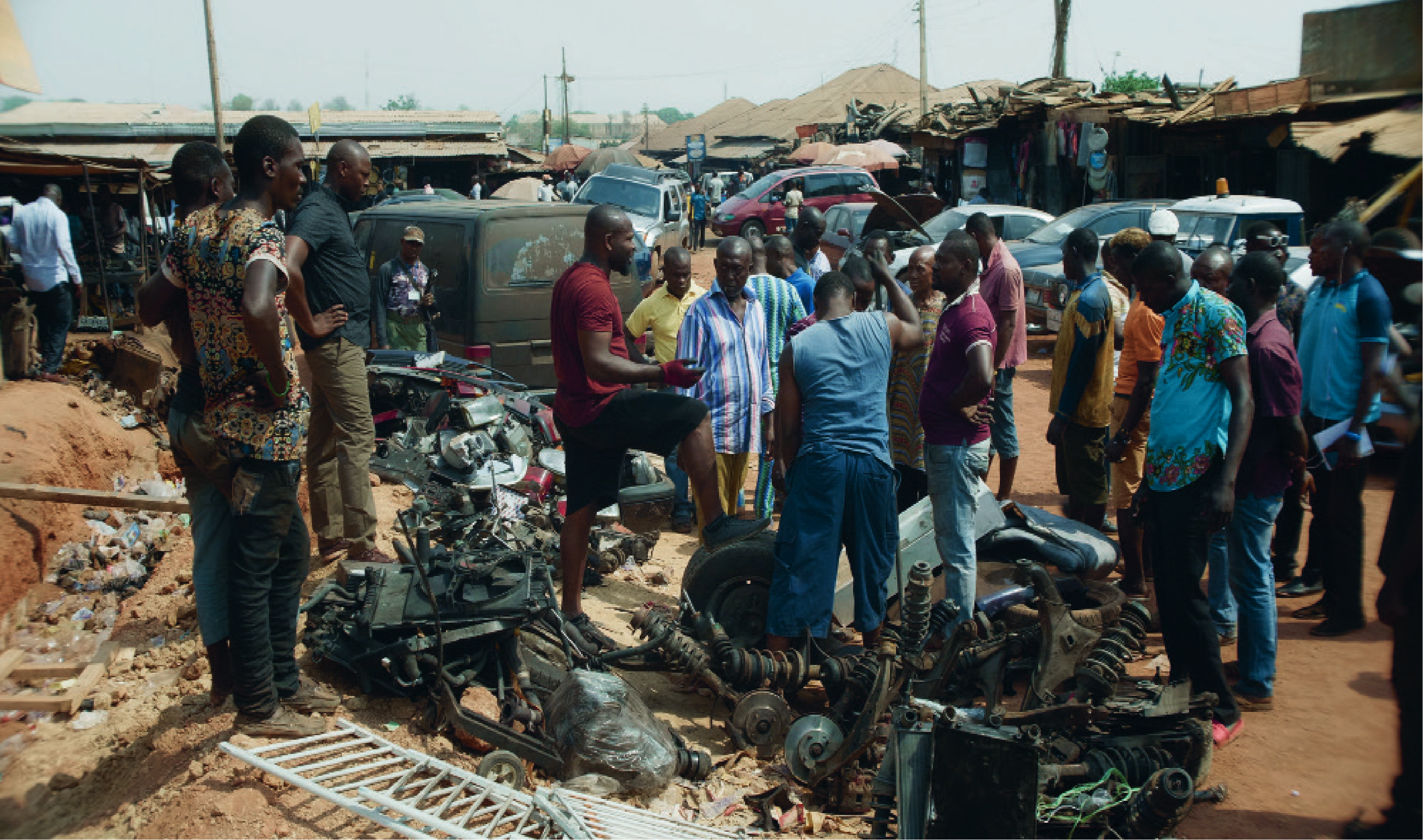
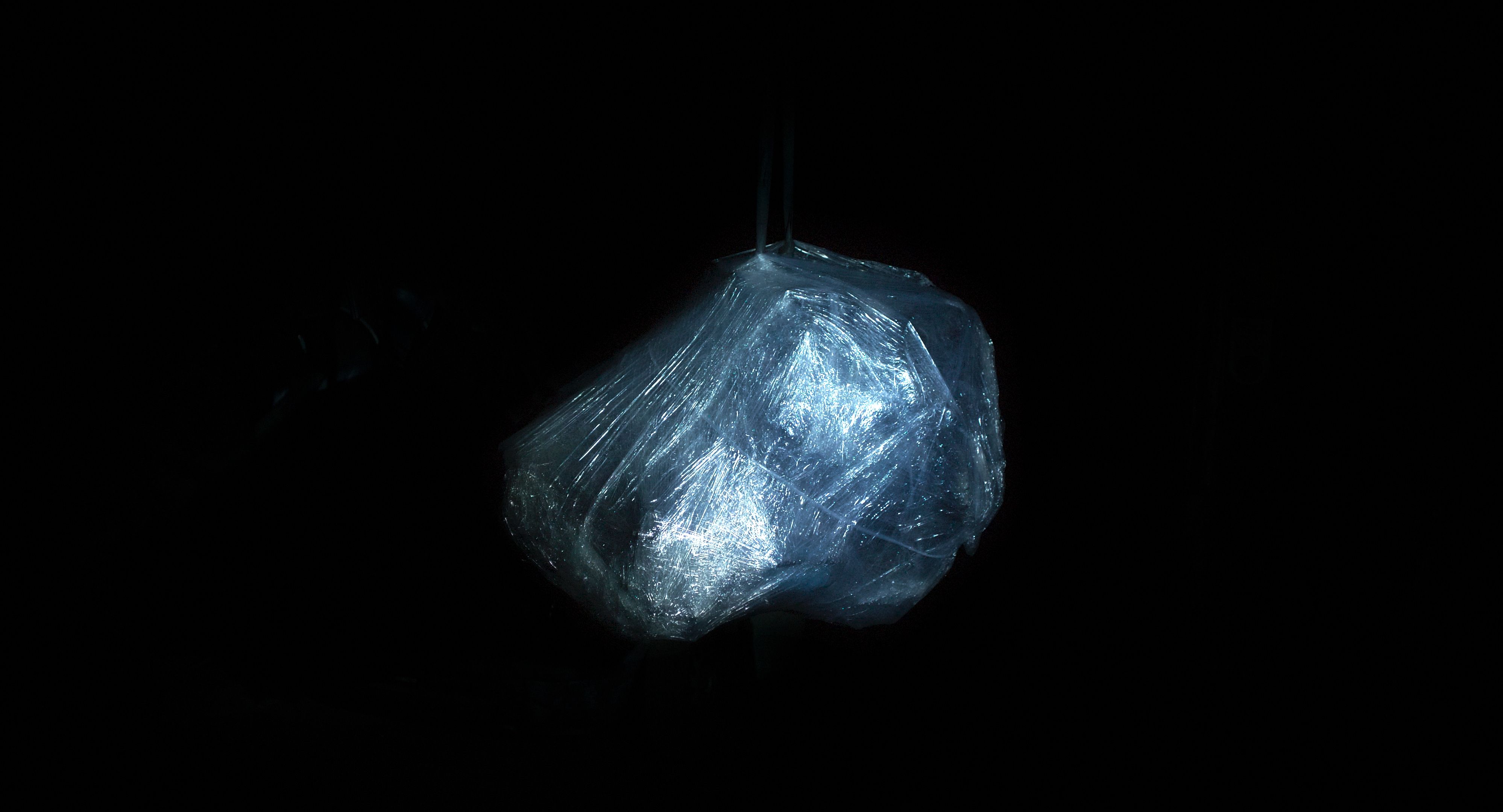
II. Movements of a Nearby Mountain is however also a film about myths and histories and systems and ideas created by realities (and markets): the block of text at the beginning of the film briefly summarizes how the iron in the Erzberg (literally: ore mountain) has been mined since the Roman era and the legend according to which it will never dry up. Cliff twice tells the myth of the waterman who brings people iron for all eternity — once in German, once in Igbo. Not only is iron, not only are brake disks and spark plugs exported. An idea and a promise are also exported. With each of Cliff 's resold cars, Erzberg also comes closer to Nigeria. Behind the visible, physical work, the film reveals a narrative dreaming of the global market: when Cliff disassembles the motor of a chosen vehicle that is elevated in the air by a forklift and encased in plastic wrap, it somewhat resembles a gemstone and a cocoon and the soon to be exported motor becomes a symbol of a wish for the constantly renewed creation of value. One wants to think that the trip to Nigeria does not feel like a homecoming for Cliff. He even looks isolated in the market and later goes on a walk alone in the woods. Not a return to nature, but rather the feeling of isolation; the presence of animals and insects, the wind and the ground. Pausing, he looks at his phone for a while, just as he did at the beginning of the film. We see an image of his friend Magnus on it who is (probably) sitting on a rock near the warehouse in Styria, a little like a waterman, in blue overalls and with a phone to his ear. Magnus appears again and again during the film. A ghostly presence, we do not hear his foot- steps, but he nevertheless speaks — very concretely — about auto parts and taxi businesses in Nigeria. Stories and thoughts constantly jump out of the documentary observations, inciden- tal and yet insistent, and create connections between the objects and people.
III. On a diffused, foggy threshold Movements of a Nearby Mountain moves between the material world and the ghosts surrounding it — the market, money, and myths deposited in it. On one hand, the world's concrete, haptic physicality, the presence in the present and its imperma- nence, the rust (which is also repeatedly a subject of the minimalistic “poetics of negotiation” between Cliff and occasional buyers who pop up), traces of the neighboring, abandoned paintball field, and the feeling that Magnus was once there, entirely real, as Cliff 's friend, brother, or business partner. On the other, the myth of eternity, the legends of never-ending raw materials, and the chain of exploitation derived from them, the suspension of time and space. At the end, the sound of Nigeria's heat in December is laid over a long, hypnotic phantomride through a wintry Erzberg landscape, a foggy mountain in the distance. Cliff, the iron, the market — they are always and everywhere together, strangely present, even if they can also hardly be conclusively placed.
From Bilder, Falten (Le Studio Edition 1)
Alejandro Bachmann, 2019
The road now leads south
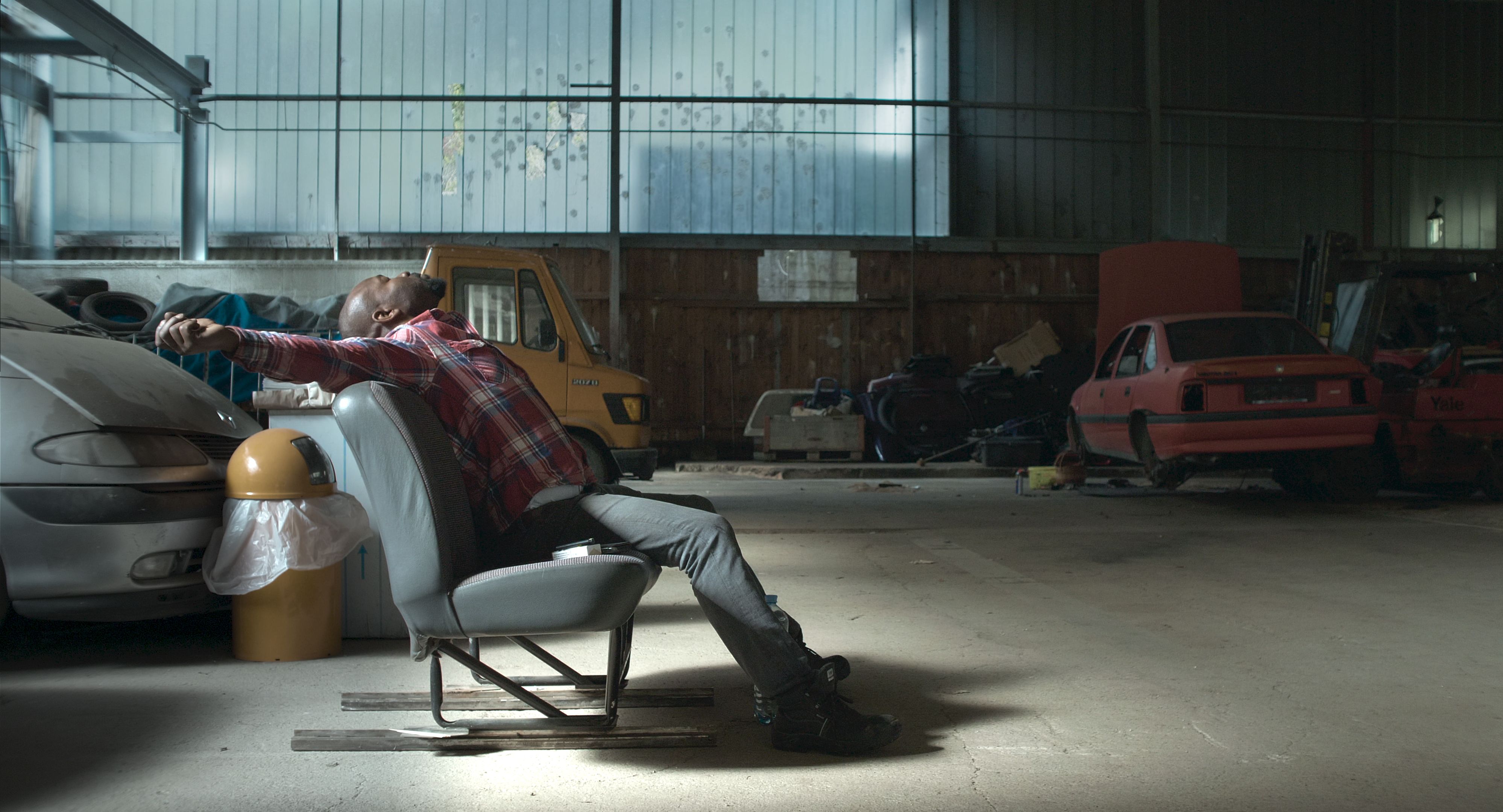
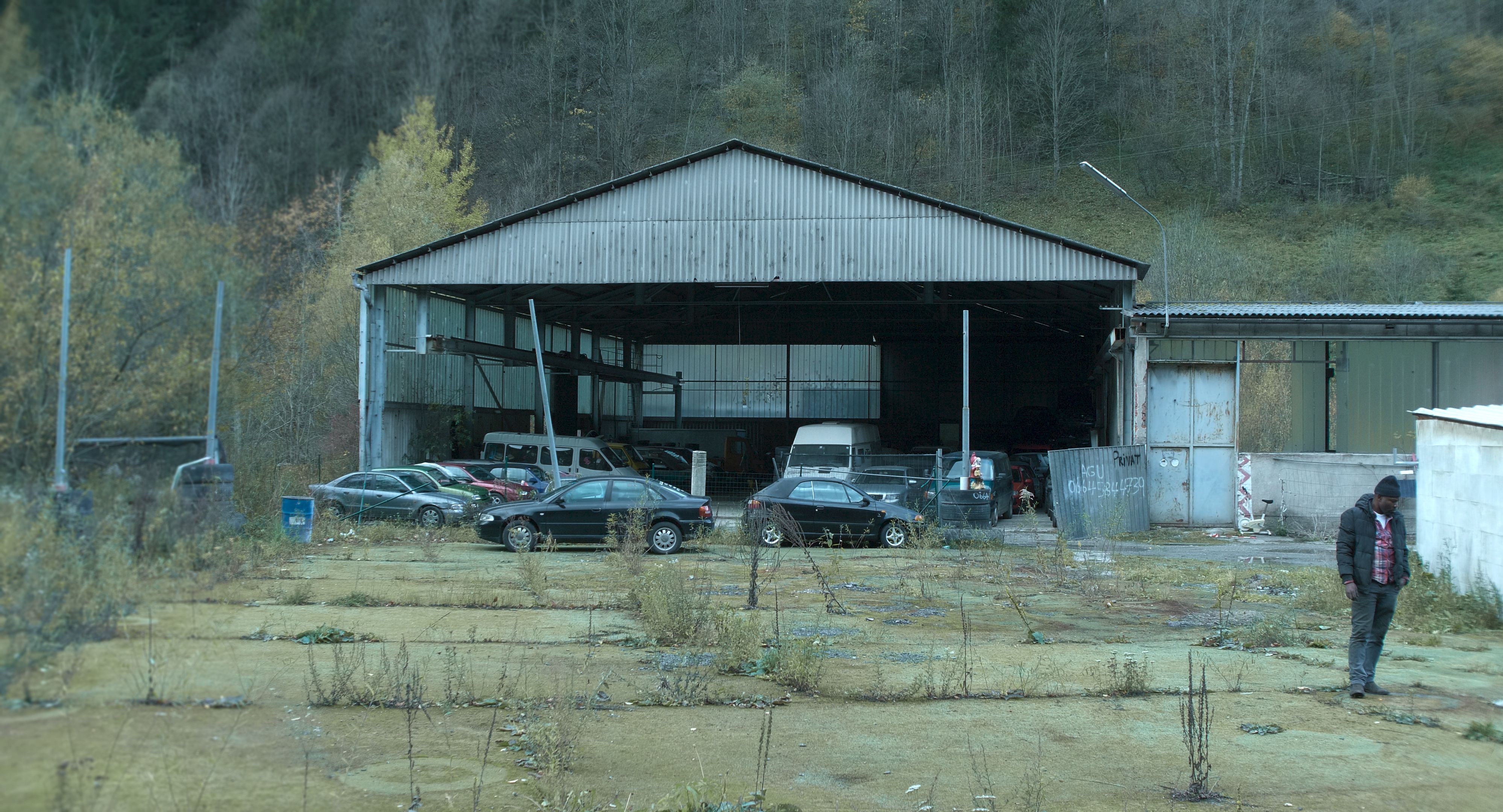
The tools are rudimentary, but they get the job done, the bread knife, the hammer, the drill and its various attachments. Screws are removed, wires sliced through, and entire sections disassembled and put aside, sometimes with patience, sometimes with brute force. He works alone and it takes time for the individual parts to emerge from the whole, the ones stacked up in the far corner of the warehouse, the bumpers, the exhaust pipes, the tires, like bones scrubbed clean of flesh. When the old engines are hung up to let the oil drain out of them, it's as if they're suspended on meat hooks, afterwards they're wrapped in cling film, although they hardly need keeping fresh. He usually works in silence, except for the few times he hums a song to himself, the tools also bang, metal scrapes across the floor and motors run; every clank echoes. The space is large and the camera is as patient as he is in exploring it, first pick- ing out the different sections of the hall, before stepping out to the forecourt outside, weeds pushing up through the concrete, to the small hut where he cooks, to the bridge where he collects the water from the stream; the steep wooded slope behind the fence is already part of the mountain.
Later on, the view widens, to take in the paintball field, the terraces carved into the rock, some bare, some already green, and the quarry from which iron still flows, just as the water sprite promised it would, albeit without saying in which direction and which form; the road now leads south. Sometimes the trees have leaves and sometimes they don't, sometimes it's brighter and sometimes it's more overcast, but up here the quality of the light hardly seems to change across the seasons, the window panels on the upper half of the warehouse are milky enough to diffuse the sun's rays anyway, only adding to the sense that this is a place apart, a separate realm; when he starts talking to himself, about the details of the work, about the paintballers across the way, about Nigeria, it can feel like someone else is there. He does sometimes have visitors, they stop in to buy or sell or both, they talk wear and tear, ages and brands, they haggle, they speak German together, but it's seldom their mother tongue, just the lingua franca of this realm, of this economy, of the time. Perhaps some of them have come thanks to the cards he leaves tucked into the doors of the parked cars, of which there are far more than people, these are the only moments he leaves the warehouse. When he drives trough the surrounding landscape to distribute them, the light is different, greyer, colder that it is at home, like something dimmed, diminished, nearly used up.
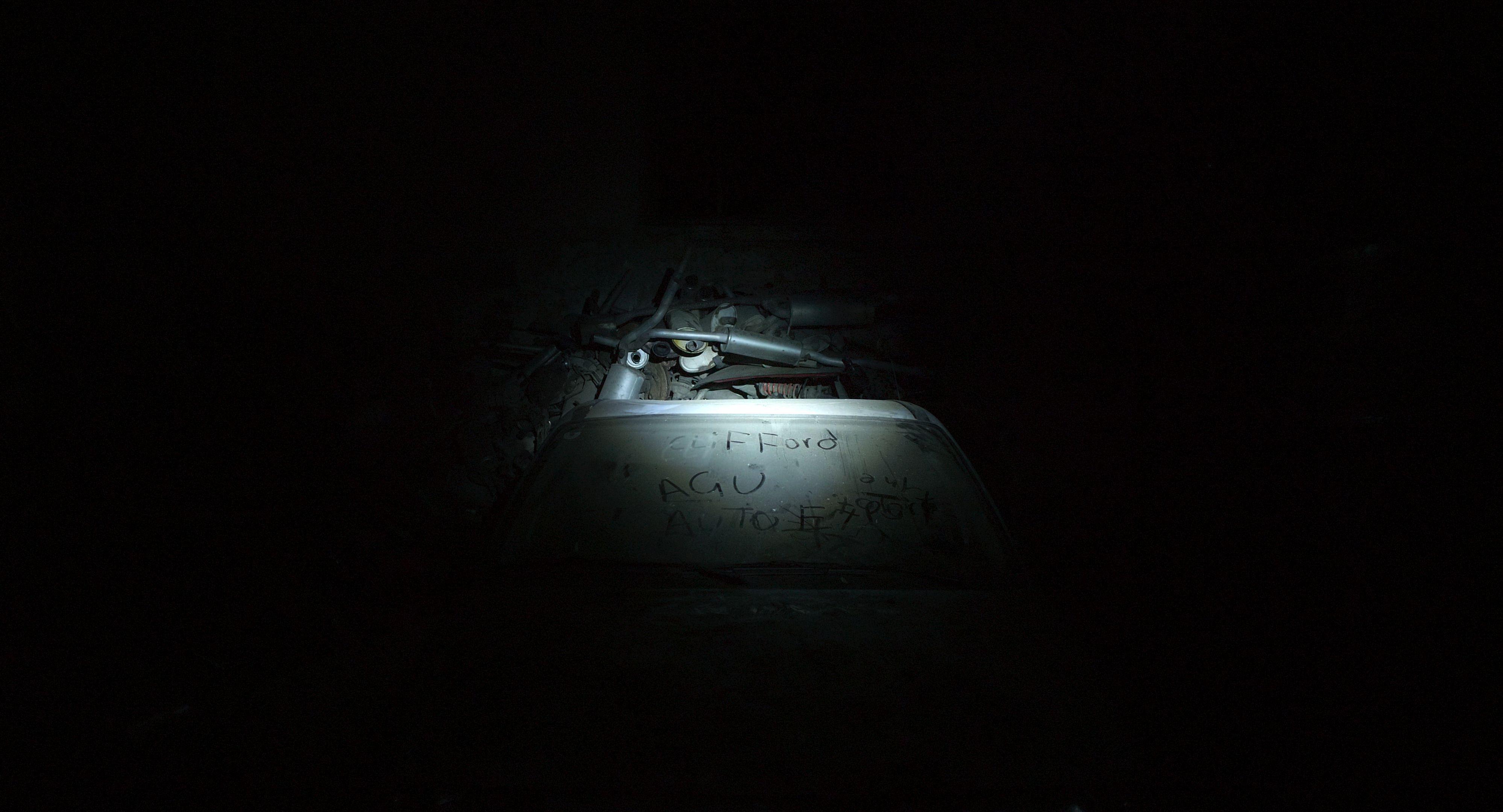
The torch passes over many things in the darkness: names and numbers written in dust on the windscreen, another engine wrapped in clingfilm, the door that leads to the other room, fronds yellow in the light, more vegetation behind, far too green for Austria. The voice, his voice, speaks once in German, once in Igbo: a golden foot, a silver heart, or an iron hat, a mischievous finger pointing to the nearby mountain, an end to enslavement, an echo over the valley, the sound of laughter.
James Lattimer, 2019
An imminent end or new beginnings
In his third feature, Sebastian Brameshuber purposefully recycles some images from Of Stains, Scrap and Tires (2014), a 16mm short filmed in the same car business nestled at the foot of the Austrian Alps, below the mists of Erzberg, one of the country’s largest iron ore deposits mined since Roman times. Here, nothing dies completely, everything is reused, recovered and remembered. Cliff, a Nigerian mechanic, tours car parks looking for vehicles to recondition and break up, which he then sells or exports as spare parts. Formerly, his large three-walled depot opened onto a paintball field; but now most of the customers on his horizon are from Eastern Europe, and Africa, where his parts find a small market. The calm observation, listening and exploration of labour, materials, exchanges and territories are what connects this Nigerian microcosm to economic relations across Europe and Africa. Through his materialist approach, Brameshuber links the exploitation of iron to the earth spirits and contemporary leisure activities. While the sound track of Nigerian forests is superimposed on the images of Austrian peri-urban areas, the owner recounts a founding myth that, underneath its ironic promises of eternity, speaks of the depletion of terrestrial resources, be it an imminent end or new beginnings.
Cinéma du réel
Antoine Thirion, 2019
“Movements of a Nearby Mountain has a graceful pace and remarkable elegance. It is a mysterious and entrancing look at a life in motion in a dreamlike and surreal space. The third feature by Austrian filmmaker Sebastian Brameshuber is a rare gift.”
“Brameshuber has achieved that wonderfully simple thing where all you have to do is look and see and listen to what is happening on screen in order to get closer to another human being,where in the process of watching everything is revealed, and simultaneously kept mysterious.”
“Sebastian Brameshuber’s contemplation on these contrasts and the intimate portrait of one man against the stunning forest backdrop speaks volumes without saying much.”
“A film in midstream, neither depraved of strangeness nor of relevance. The mountain’s eden-like purity, the remains of productivist civilisation, a metaphor of recovery, completeness of a film-tableau.”
“A documentary which is ascetic without being dry, simple yet profound and which knows how to impose its own rhythm on proceedings.”
“More real than reality, and stranger than fiction.”
"You leave the cinema impressed by Brameshuber’s ambition to fit the entire world into a single film."
“Thanks to the elegance of his mise en scène and inventive use of the off-screen dimension, the filmmaker managed to move us with the profound humanity of his protagonists.”
“The winning film exemplifies an assured coming together of form and content to craft an intimate portrait of a character whose daily life illuminates a global conversation about labour, movement and capitalism. From the patient gaze of the camera to the perfectly paced, rhythmic cadence of the edit, there is a precise intentionality in each element of the visual and sonic landscape. This elegant economy of form holds space for the imaginative and poetic dimensions of myth and the tactile materiality of work.”
“Uprooting, migration, adaptation, life and survival are processes both distant and omnipresent and affect people as well as things. Sebastian Brameshuber lends cinematic form to these movements of thought, demanding a magical materialism that is as unpretentious as it is elaborate.”