
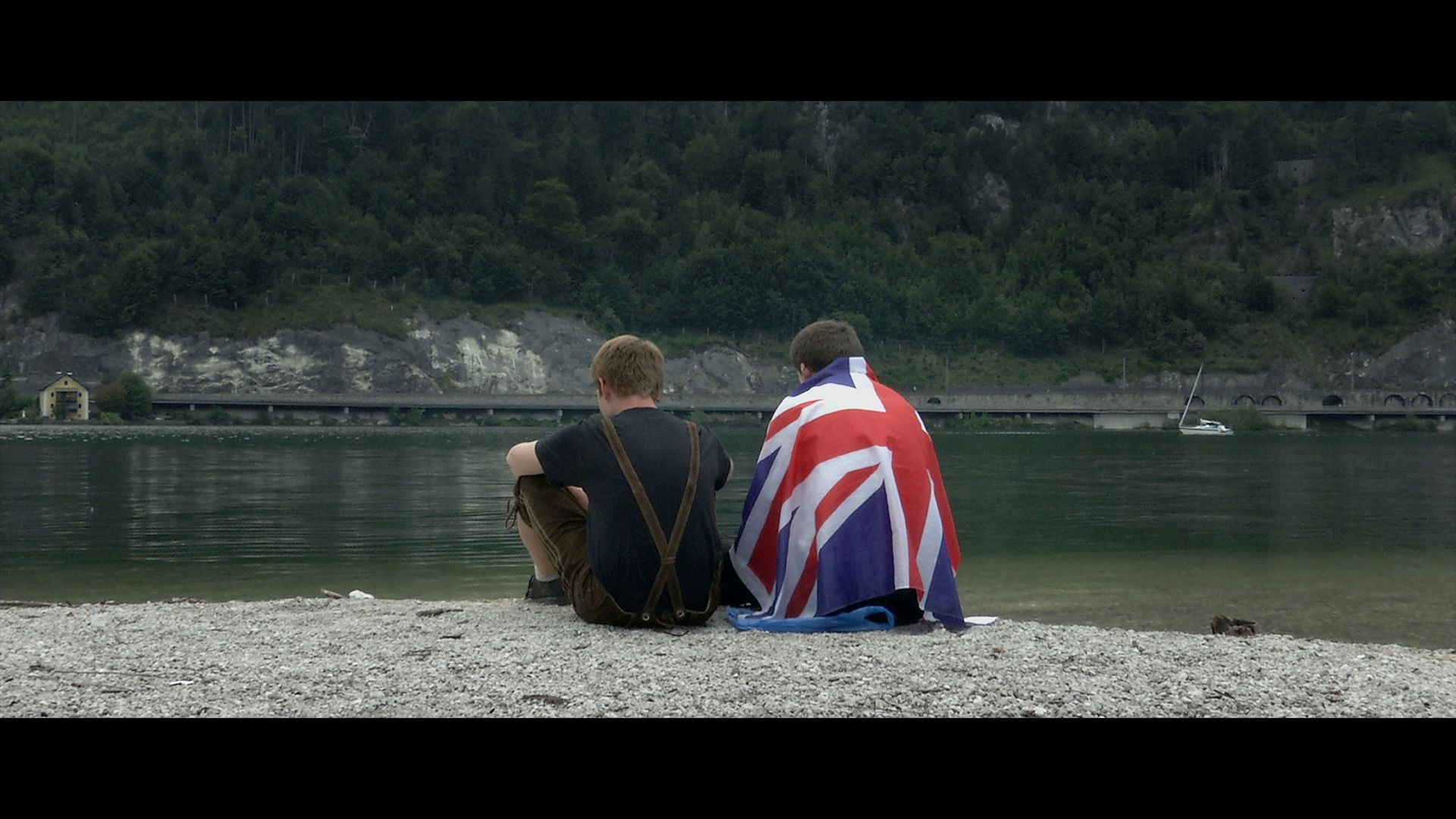
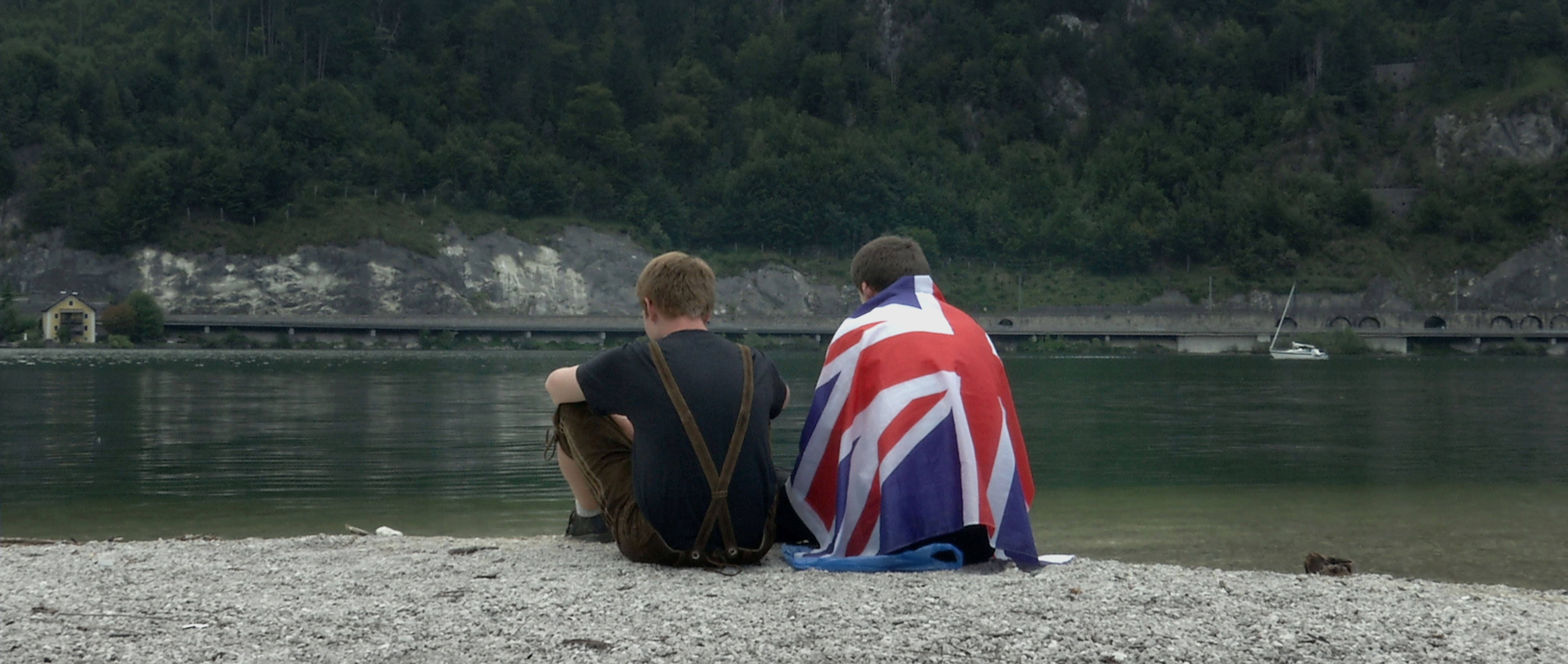
And There We Are, in the Middle
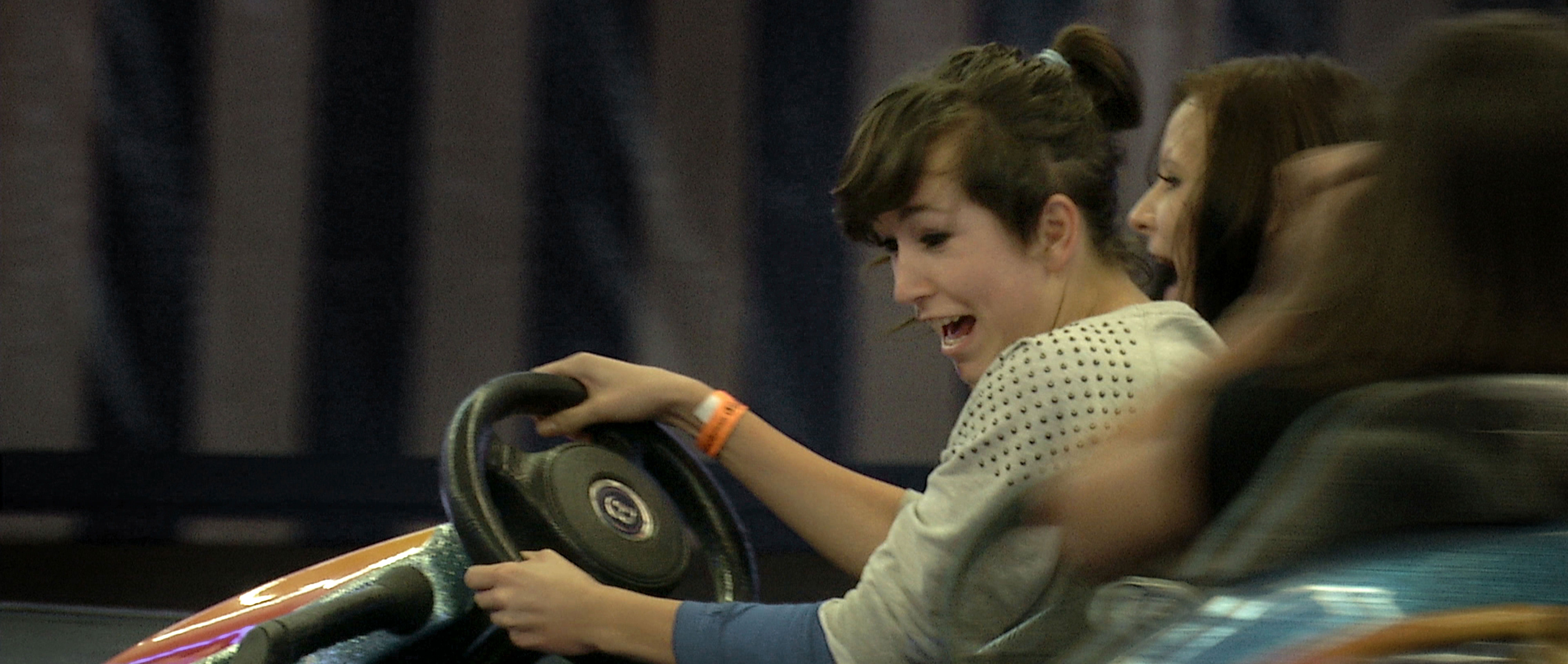
Andi plays the electric guitar and is mad about guns. Michi hopes his Doc Martens show the right political stance. Ramona is looking for an apprenticeship and has her heart set on a lip piercing. These three 15-year-olds live in Ebensee, a village in Austria where in 2009 the annual memorial ceremony at the former concentration camp was disrupted by a group of youths with air rifles. For a year, the film follows its three protagonists, painting a poignant picture of the complex process of adolescent self-discovery and personality development. And of how short the path can be when shifting between vastly different concepts of identity.
Country, year
Austria, 2014
Runtime
91 min
Writer, Director
Sebastian Brameshuber
Cinematography
Klemens Hufnagl
Editors
Emily Artmann
Sebastian Brameshuber
Elke Groen
Sound
Hjalti Bager-Jonathansson
Marco Zinz
Sound design, Re-recording mixer
Marco Zinz
Producer
Gabriele Kranzelbinder, KGP Kranzelbinder Gabriele Production
Film format
HD 1:1,77
Screening format
DCP 2k, 1:1.29 (scope), Dolby 5.1
Supported by
ÖFI
ORF
FISA
Kultur Land OÖ
Zukunftsfonds Republik Österreich
Kultur NÖ
Austrian release date
June 13, 2014
Distribution
sixpack film
World premiere
Berlinale Forum 2014
Festivals (selection)
Berlinale Forum 2014
Diagonale, Festival of Austrian Film, Graz 2014
Crossing Europe Filmfestival, Linz 2014
DMZ International Documentary Film Festival, Seoul 2014
Entrevues Festival International du Film, Belfort 2014
Kasseler Dokumentarfilm- und Videofest 2014
One World Romania Film Festival, Bukarest 2015
Awards
Nomination, Österreichischer Filmpreis, Best Documentary 2015



1/3
Excerpt from the interview “A Distrust of Myself, of the Other Within Myself” — P. 4
by Alejandro Bachmann
From Bilder, Falten (Le Studio, Edition 1)
The known unkown
Finding words for a film that I assembled over the last years, months and weeks from loosely connected moments into a fragile whole (or better: into a suggestion for a whole) presents me with a challenge. It still feels to me as if I were viewing Und in der Mitte, da sind wir on a huge movie screen from a distance of just ten centimetres. Taking my starting point from the title, which suddenly occurred to me during the lengthy editing process, I would like to think about this film and share my thoughts and associations in the following.
1. Geographic centre
One aspect is the geographic centre extolled at the beginning of the film. Ebensee is one of the many centres of the universe, a place I've known since childhood and in direct proximity to where I grew up. There is a traditional, intense competition between my hometown Gmunden, a small city on the northern shore of Lake Traun, the centre of the universe, and Ebensee on the southern shore. In Gmunden it is assumed that 'uncivilised' people are at home in Ebensee; in Ebensee the Gmunder are vilified as 'swelled-headed' snobs. As a schoolboy, I found it unpleasant when the Ebensee children with their conspicuous dialect stormed onto the school bus halfway between Gmunden and Bad Ischl, where I attended high school. During a stay in Istanbul in May 2009, when I learned in the Turkish media of an incident at the former Ebensee concentration camp, the first thing I thought was: 'Typical of Ebensee.' A moment later I was amazed at my reflex and began questioning this prejudice from my childhood and youth. And that's how this project began.
The Salzkammergut region has a centuries-old salt industry. The salt was mined in Bad Ischl, processed in Ebensee and traded in Gmunden. Gmunden, on the sunnier side of the lake, grew rich; Bad Ischl, as the summer resort for Empress Sissi and the Austro-Hungarian court, grew rich and famous. Ebensee remained the rather impoverished workers' town on the dark southern shore. In 1943, the Nazi leadership decided to install a satellite camp of Mauthausen concentration camp in Ebensee. The people of Ebensee are still working through this legacy with little success. A small segment of the population, together with the local museum of current history, acts decisively against forgetfulness and tries to shift the focus from shame and guilt to a more timely exploration of the issues, but encounters wilful ignorance and rejection from most of the residents. In this, Ebensee is no exception, but is typical of all of Austria. Why should people in Gmunden or Bad Ischl, fifteen kilometres away, have less reason to concern themselves with the Nazi past and be able to delegate this duty to Ebensee, so to speak? What remains swept under the rug elsewhere for lack of occasions merely comes to a head and appears in Ebensee.
2. Between societal margins
At the centre of this film are not marginal milieus and outsiders, but the middle of society. By birth and descent, I will remain particularly tied to this middle all my life. In the last three years, friends and colleagues have often asked me, usually with a smug grin, how far along I am with my 'Nazi film'. For make no mistake, not only Austria's rural youth but also a large part of its so-called cultural elite seem to have had enough of remembering. But they know how to maintain appearances by giving lip service at the right moment.
Yes, National Socialism and the burdensome legacy it left in this country are a theme that, in the meantime, is treated in a rather inflationary and often extremely shallow manner. As a filmmaker, one is often suspected of addressing it calculatingly. But to abandon the field would seem to me a negligent capitulation, not only to the passage of time and to forgetfulness, but also to the here and now and to current societal and political developments. I admit: I too am anxious about someday having no more hair on my head, sometimes more than about the advent of a 'Fourth Reich'. But that's not the point; the point is to look and listen, to try to find a new facet in a discourse that has become sometimes redundant and to make suggestions for a differentiated and timely exploration of a complex theme. I see this film as such a suggestion. This brings me to the third association I have with the film's title. But perhaps I'll first speak about a fourth, so that what the film primarily treats does not end up in the background.
4. Between childhood and adulthood
I mean that hormone-pervaded middle that we call youth, halfway between childhood and adulthood. A beautiful, crappy time beautifully crappy that I guess everyone eventually remembers with mixed feelings: what nonsense we thought, spoke and maybe also did. Is anything left of the self I was back then, and if yes, then which part? Who or what made me what I am my family? Friends? School? Coincidence?
It seems just a moment ago that I was the world's greatest Michael Jackson fan. Then my older sister's cool friend appeared on the scene as a hip-hopper. Where is the next shop where I can buy baggy pants? - and immediately, because I want to be a hip-hopper tomorrow already, if that's okay. Or, even better, if it's not okay. When I was a teenager, my hip-hop outfit was just enough to modestly provoke my grandparents. To my frustration, my parents didn't care at all. An existence constantly in-between: between a still meagrely defined self, friends, parents and school (or workplace), the here and now and a future still to be shaped but constantly getting closer and for which I was supposed to decide and that threatened to put an abrupt end to that incomparable, never to return, seemingly everlasting today. Between desire and the (hormonal) imperative to either conform or to rebel, to be adequate to the field of tension between aspiration and reality, a field whose priorities constantly change - or not to.
3. Between aspiration and reality
Aspiration, reality and the in-between. Those are the keywords that bring me back to my third association, the one that has to do with remembering. Aspiration: that is the discourse, which never really fully arrived in Austria anyway, of the devoir de mémoire, the duty to remember. A task, an ideal, a utopia. It will have been. The grammatical form of the future perfect, writes Harald Welzer in his essay 'Erinnerungskultur und Zukunftsgedächtnis' (the culture of memory and memory of the future), is an expression of the human ability of 'anticipated retrospection', of being able to look back on a future that hasn't even become reality yet. It's almost crazy that I, human that I am, am able to do this. What all would be made possible, what could be prevented, if humanity, taking recourse to what is past, could subject what it has already learned, its thinking and its actions to the logic of the future perfect.
Reality looks different, and for Ramona, Michael and Andreas, the youthful protagonists of this film, between aspiration and reality lies what we call everyday life, on the one hand. The search for a place in this world places considerable demands on them, and it's not hard to imagine that, between homework, appointments at the labour bureau and onerous if well-meant parental suggestions, the next parish fair is more important than celebrating the liberation of the former concentration camp. That's the one side.
5. Between rascals and neo-Nazis
In May 2009, at least eleven boys from the town disturbed the annual liberation celebration at Ebensee concentration camp by lying in ambush in one of the former camp's underground factories and shooting a group of visiting survivors with air guns, abusing them with Nazi slogans and, some in ski masks, goose-stepping back and forth in front of them. The national and international press reported on a planned neo-Nazi action. Shortly thereafter, charges of 'repeated offense' were filed against four of the participating youths, who were between fourteen and eighteen years old at the time of the crime.
In stark contrast to that, people in the town were sure that these were not neo-Nazis. The kids hadn't known what they were doing and had no clear idea of the significance and consequences of their actions. Actually, they are nice boys who merely say stupid things sometimes. It was a tremendous exaggeration to file charges and take them to court. Local residents thus turned 'neo-Nazis' into 'rascals' and then right away stylised them as 'victims' of a politically over-correct society. Both interpretations, the 'neo-Nazi action' and the 'prank' are vastly inadequate and ultimately serve only to calm the public by either pushing the participants to the margin of society (neo-Nazis) or rhetorically retarding them forcibly into the protective framework of childhood (rascals). A contradiction emerges between the official view of the incident, shaped by the judiciary and the press, and the little community's world. People can't imagine that these boys, close to them as children, friends, pupils or schoolmates, are responsible for an offense that is suddenly found in the context of the greatest crime in human history. This overlapping of current and older history prompted one of the defence attorneys to remind the jury that the youths were not charged with the National Socialists' crimes. There was much criticism in Ebensee of the media reporting, which was felt to be one-sided, but the town itself, including its schools, made no effort to deal with the incident. This, too, reflects Austrian dealings with unpleasant history.
6. Between camera and cinema audience
The youthful protagonists found themselves in the middle while we shot the film, as well: between their desire to take part in the film and to share very personal aspects of their lives with me, the camera and a public, on the one hand, and my expectation, on the other hand, to make a film that did justice to their lives without bracketing away the recent and very recent past, the blind spots, the 'holes in the mountain', the known unknown.
The decision to 'lock them up' in images with largely strict framing while the camera observed, questioned and interpreted them, in order to formally counter their hardly predictable bursts of youthful energy, makes me as filmmaker recognisable as another inquiring instance and authority (along with parents, school, institutions, employers etc.). The voices of adults, including mine, intrude on the youthful universe like interfering frequencies and make the attempt to break through the protective sheath of the faceless, eternal present with annoying questions about the future and past. The camera usually remains at a respectful distance. I didn't want to be the young people's friend and confidant, but a counterpart who takes them seriously and with whom, despite everything, their story is in good hands. Now it is a movie audience that will watch them on the screen and subject their actions, their choice of words etc. to a new and I hope sympathetic - evaluation.
Berlinale Forum 2014 catalogue
Sebastian Brameshuber
Topographies of transition
The middle is an ambivalent place. At a safe distance from the precipitous terrain of the peripheral areas, it stands, on the one hand, for stability and safety, for a healthy dose of something in between. On the other hand, seeking the middle ground can also mean searching and hesitating, being stuck halfway between childhood and adulthood, social expectation and inflated ego, altar boy and punk rocker, Ischl and Gmunden. Just like Michi, Ramona and Andi. Just like Ebensee, which is situated at the Traunsee in the Upper Austrian Salzkammergut and is the setting of Sebastian Brameshuber’s And There We Are, in the Middle.
Someone has sprayed “Ebensee Crime” on a bridge—a slogan that is stuck somewhere in the middle between antifa and a Salzkammergut whodunnit. A few teenagers gather between the bridge and the underpass. “Up above is Ischl, down below is Gmunden, and in the middle here we are …” Those are the sounds coming from a mobile phone playing the kind of song that can set rural Austrians swaying gently back and forth as they sing along. In Brameshuber’s film, however, there is little to be seen of the “beautiful place” that the singers are thanking God for helping them find. Again and again, Brameshuber, who himself comes from “below,” that is, Gmunden, uses architectural structures of transition, uninhabited and clandestine, to frame his protagonists: railroad platforms, underpasses, tunnels. Despite their being anchored in the everyday rituals of the teenagers, these dark, somewhat cave-like topographies, most of them presented in wide, precisely framed shots, are also after-images of a place that projects from the past into the present: the Nazi concentration camp at Ebensee. Built in 1943 under the codename “Zement” (“Cement”) as one of the numerous sub-camps of the Mauthausen concentration camp near Linz, it was intended to provide huge numbers of enslaved workers to build a large-scale underground armaments project: the relocation to bomb-proof tunnels of the Peenemünde rocket research center in northern Germany. Some 8,500 people lost their lives at the Ebensee concentration camp, more than the town’s population today.
The film’s focus is on the Ebensee concentration camp and the associated culture of remembrance and commemoration, which has often been understated or ignored. The commemoration ceremony in May of 2009 was disrupted by a small group of local youths who shot at a group of visitors with airsoft guns and insulted them with Nazi slogans. The incident, which triggered widespread media coverage (in the international press as well) inevitably affected the self-image of the people of Ebensee. It recurs cyclically in the film with reserved insistence, always using Michi, Andi and Ramona as vehicles, although none of them was actually involved in the incident. Brameshuber filmed the three fifteen-year-olds for just over a year. He is present as an off-screen questioner, always positioning himself as an opposite, always on the “other side” in terms of viewpoint and image. Brameshuber prefers to film the youths in frontal view, usually in tightly framed shots that also isolate them from social interaction—for example, when the people they are conversing with are not shown. The stability of the image contrasts with the sometimes hesitant, sometimes unsteady movements of their lives.
“I’ll stay as I’ve always been/Because I can’t help it!/Punk is meant for me/Punk I was already as a child/Punk I’ll be as an old man/From kindergarten to old folks’ home ...”, the Oi!-punk band Pöbel & Gesocks proclaims boisterously in the song Punk—a narrative that is almost antithetical to the identity-finding processes of the film’s young protagonists. Michi is first introduced as a Ratschenbua, shaking a wooden rattle at Eastertide in an old Austrian custom, then strongly identifies himself with Michael Jackson, and finally devotes himself with visible effort to being a punk during his restaurant training. His playlist includes the aforementioned song as well as Das ist Ebensee by the Kohlrösserl choral society. He openly displays his affiliation by observing the proper dress code—Doc Martens and a Pöbel & Gesocks sweatshirt—but whether that really does the trick is question-
able. “Are you a punk now, Michi?” Brameshuber wants to know. The boy’s answer: “I hope ... that I’m on the right side.”
And There We Are, in the Middle also shows how difficult it is to translate personal interests into a career choice. Andi has many passions, which he pursues with great earnestness and self-control. He calls himself a “war fanatic” and claims to have “always” been interested in weapons, is a member of the shooting club, and loves his electric guitar. But he seems less organized when it comes to shaping his future. A visit to the advice center rather affirms his feelings of insecurity in the face of countless options—the “interests test” suggests that he become a skilled worker in a cheese factory, a surveying technician or a computer scientist, among other jobs. Ramona lives with her mother in the housing complex built on the former concentration camp site. After the war, people were in a hurry to erase the traces of the crimes, and only the archway that served as the main entrance to the camp remained. Ramona picks up job applications and goes to preliminary interviews, but the only project she gets excited about is her plan to have her lip pierced.
In And There We Are, in the Middle, the dining table becomes a setting for conversations and questions that not only reveal generational differences—for example, when Michi’s father declares that he is too old for the subtleties of political dress codes. Last but not least, the searching movements of the youths resonate in the parents’ helpless handling of Ebensee’s history and culture of remembrance. The incident in May 2009 was a “boyish prank,” we hear at one point, and we should “let things lie and not bring them up again.” Even more than thirty years after the Waldheim Affair, which a former politician of the ÖVP (Austrian People’s Party) tried to stifle with the argument that one should not “awaken feelings that we all do not want,” a reassessment of history and especially of its historical continuities is often regarded as the actual “disruptive action.” This kind of speech can be heard increasingly today—in a wide variety of places and in much sharper tones. You don’t have to go to Ebensee to hear it.
From Bilder, Falten (Le Studio, Edition 1)
Esther Buss
Notes on the film
In May 2009, visitors of a memorial service in the tunnel of the former concentration camp Ebensee were shot at with an air soft gun. The teenage culprits, who also shouted Nazi slogans during this attack, made headlines; a year later they were convicted of re-engagement in National Socialist activities.
For the Austrian filmmaker Sebastian Brameshuber, this inglorious incident in Ebensee's recent history was the trigger to take a closer look at the living environments of the young people there. And There We Are, in the Middle provides a circumspect and above all impartial account of everyday life in which the incident in the tunnel functions as a reference point: parents see themselves confronted with the unspoken reproach of having dealt too little with the past; the school takes on this case with pedagogical zeal; and the girls and guys have to respond to this misdeed and the Nazi past, because they themselves, so to speak, have fallen into disrepute with the whole town.
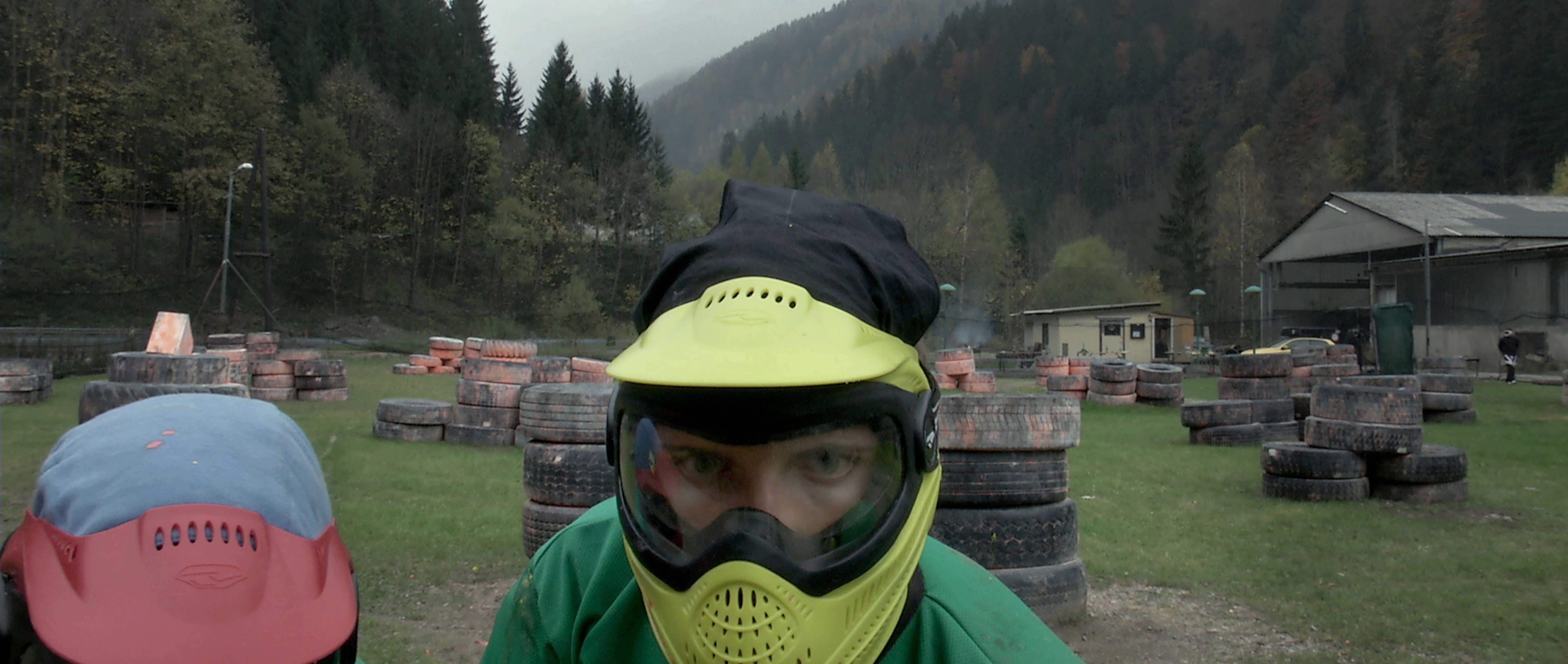
In clearly and thoughtfully framed shots, Brameshuber empathizes with the young people who, in their search for identify, between ending, respectively, dropping out of school, the first jobs and testing out different youth cultures, seem somewhat disoriented: which path should one take and which goal pursued? The possibilities in town are limited, even the offer of a new shopping center is a bust - there is not even a McDonald's. The film's points of contact often result associatively, like, for instance, in the scene in which Andi and a friend explain their enthusiasm for firearms: "I'm just a little bit of a war fanatic".
However, it does not remain at seemingly one-sided attributions; this already guarantees a temporal perspective - the space of a year in which a lot can change in the life of an adolescent. The developments that are a matter of course at this age are especially striking with Michael, who develops from an avid Michael Jackson fan and imitator into a nihilistic punk on his buddy's side - and finds himself having to explain his actions to his parents. The process appears moderated with Ramona, who does not really have a proper idea about her future, but also does not unnecessarily worry about it: The only thing is that there is always too little time.
The feeling of alienation and social disconnection is strong. Yet Brameshuber makes clear that his protagonists are indeed involved in a social exchange. Whether it is a family council where the parents show themselves hardly receptive to the culture of remembrance surrounding the concentration camp, or whether it is a job application or counseling session: the connections to the adult world are existent; the identificational effect is slight. The title And There We Are, in the Middle is loaned from a folk song that describes Ebensee's position - always the underprivileged odd man out between Gmunden and Bad Ischl.
But it also applies to the focal point of this film, which does not want to scandalize any fringes, but rather explores a vacuum that is spreading out in the middle of society.
From the film’s press kit
Dominik Kamalzadeh